

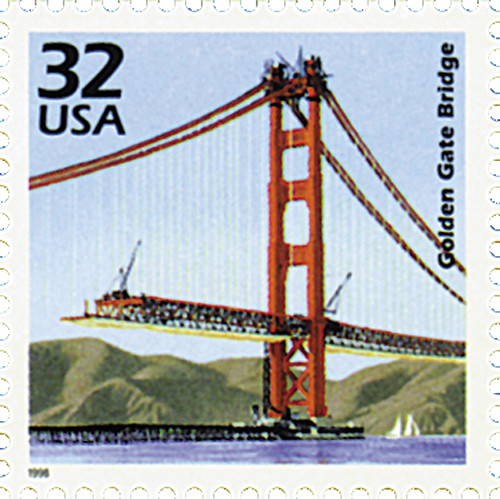
May 27, 1937: The Golden Gate Bridge Swings Open to Adventure!
The Golden Gate Bridge is a remarkable suspension bridge that spans the Golden Gate Strait, a vital connection between the San Francisco Bay and the Pacific Ocean. It links the city of San Francisco to Marin County in California, carrying both U.S. Route 101 and California State Route 1. Besides vehicular traffic, the bridge accommodates pedestrians and cyclists, making it a key feature of U.S. Bicycle Route 95.
Notably recognized by the American Society of Civil Engineers as one of the "Wonders of the Modern World," the Golden Gate Bridge stands as an iconic symbol of San Francisco and California, celebrated globally for its beauty and engineering prowess.
The conception of a fixed link between San Francisco and Marin gained traction in the late 19th century, but it materialized only in the early 20th century when the technology became viable. Chief engineer Joseph Strauss, along with notable contributors like Leon Moisseiff, Irving Morrow, and Charles Ellis, brought the bridge to life. The bridge officially opened to the public on May 27, 1937, and has since undergone numerous retrofits and improvements.
Frommer's travel guide describes the Golden Gate Bridge as "possibly the most beautiful, certainly the most photographed, bridge in the world." At its grand opening, it was both the longest and the tallest suspension bridge globally, holding these records until 1964 and 1998, respectively. The main span measures an impressive 4,200 feet (1,280 meters), and the total height reaches 746 feet (227 meters).
For stamp collectors, the Golden Gate Bridge offers a unique opportunity to explore themed stamps and collectibles that celebrate this engineering marvel. Commemorative stamps featuring the bridge are often issued, capturing its stunning silhouette and rich history, making it a desirable addition to any collection.
To learn more about this iconic structure, visit this website.