

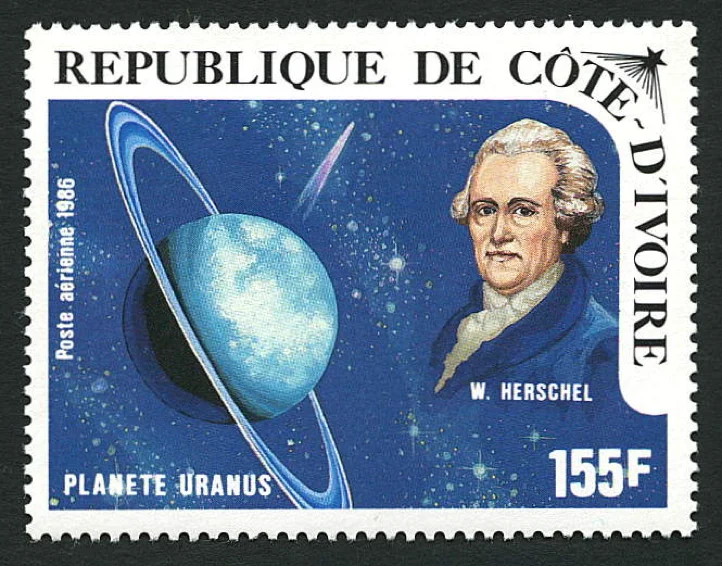
March 13, 1781: The Day Uranus Stole the Spotlight!
Frederick William Herschel was a remarkable German-British astronomer and composer, whose findings have had a lasting impact on astronomy and the sciences. He made his most notable discovery on March 13, 1781, when he identified Uranus, the first planet discovered since antiquity, which brought him instant fame and recognition within the scientific community.
Herschel was born in 1738 in the Electorate of Hanover and immigrated to Britain at the age of 19. Although he initially followed his father's path in music, he turned to astronomy in 1766, building his first large telescope in 1774. This led him to conduct sky surveys that significantly contributed to our understanding of celestial bodies.
In addition to discovering Uranus, Herschel published catalogues detailing thousands of nebulae, which redefined these celestial objects. His telescope innovations revealed that many objects previously labeled as nebulae were actually clusters of stars, transforming our understanding of the universe.
For stamp collectors, Herschel is an interesting figure due to his contributions to astronomy, which may be reflected in philately through stamp series depicting celestial discoveries or astronomical instruments. His work in discovering moons of Uranus and Saturn alongside his pioneering contributions to spectroscopy, which led to the discovery of infrared radiation, play a significant role in various scientific advancements that can be commemorated through stamps.
Herschel also served as the first President of the Royal Astronomical Society and was part of numerous scientific collaborations, most notably with his sister, Caroline Herschel, also an accomplished astronomer. The influence of their scientific heritage can often be captured in stamp collections that focus on women in science or notable scientists.
In recognition of his achievements, Herschel received titles including Knight of the Royal Guelphic Order, and grants for telescope construction, demonstrating his importance in the royal scientific community. His legacy extends through his son, John Herschel, who also had a significant impact on astronomy.
Consider exploring stamp collections that represent milestones in astronomy and pay tribute to great scientists like Herschel. The intersection of astronomy and philately presents a unique opportunity for enthusiasts to celebrate the wonders of the universe through tangible collectible art.
Phenom Stores LLC is an affiliate partner for eBay.com and receives a commission on all purchases made through eBay.com.