

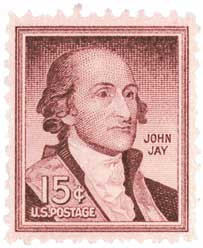
John Jay: A Pivotal Architect of American Diplomacy
John Jay (1745-1829) was a crucial figure in the early political landscape of the United States, playing vital roles as a statesman, diplomat, and Founding Father. His contributions to the nation’s foreign policy and governance are significant for collectors of stamps, particularly those interested in Americana and the historical contexts of the United States.
Born into a prosperous family in New York City, Jay's legal career was propelled by his involvement in the American Revolution. He served on the New York Committee of Correspondence, helping organize resistance against British policies. Jay was a delegate to both the First and Second Continental Congresses, where he made substantial contributions, including signing the Continental Association.
His diplomatic efforts solidified his place in history as he served as envoy to Spain and successfully gained financial support for the American cause. Jay's most prominent achievement was his role as a negotiator of the Treaty of Paris, which formally recognized American independence from Britain. This treaty is commemorated in various philatelic materials, appealing to stamp collectors interested in significant historical events.
In subsequent years, Jay was appointed Secretary of Foreign Affairs under the Articles of Confederation. His advocacy for a strong central government led him to play a pivotal role in the ratification of the United States Constitution in New York in 1788. He co-authored EDERALIST papers, which are seminal texts in American political philosophy, and are often featured in the context of stamp collecting related to American ideals and governance.
Following the Constitution's ratification, President George Washington appointed Jay as the first Chief Justice of the United States, a position he held from 1789 to 1795. Notably, his court, although not heavily burdened with cases, laid important precedents for the American legal system. In 1794, he negotiated the contentious Jay Treaty with Britain, aiming to resolve lingering tensions from the Revolutionary War. This treaty is often highlighted in historical stamp collections that focus on significant international agreements.
After his tenure as Chief Justice, Jay served as the Governor of New York, where he passed laws supporting gradual emancipation, highlighting the complex issues of slavery during his time as he owned enslaved individuals himself. Jay's decision to decline a second term as Chief Justice towards the end of President Adams' administration reflects his commitment to private life and personal ethics.
In conclusion, John Jay's multifaceted contributions to American diplomacy, governance, and legal foundations hold immense value for stamp collectors. His roles and achievements are chronicled through various historical artifacts, including stamps commemorating his diplomatic treaties, judicial precedents, and his significant involvement in the formation of the United States government.
This short YouTube video pays tribute to John Jay, one of the lesser-known but most critical Founding Fathers, by exploring the US postage stamps dedicated to his legacy in law, diplomacy, and governance.