

The Birth of the United States Coast Guard
The United States Coast Guard traces its origins back to the 1790s when the Department of the Treasury established a fleet of vessels to enforce tariffs, a crucial revenue source for the fledgling nation. On August 4, 1790, Secretary of the Treasury Alexander Hamilton successfully lobbied Congress to fund the construction of ten cutters, marking this date as the official birthday of the Coast Guard.
Initially, these "revenue cutters" were the sole naval force of the early United States, performing various duties beyond tariff enforcement, such as combating piracy, rescuing distressed mariners, and ferrying government officials.
Over time, the Revenue Cutter Service became more organized, transitioning from a loose collection of cutters to an official agency under the Treasury Department. This service not only enforced laws but also supported the Navy during conflicts, including the American Civil War.
In tandem with the Revenue-Marine, the U.S. Life-Saving Service emerged, providing assistance to shipwrecked mariners. Although the federal government began funding lifesaving stations in 1848, these initially relied on volunteer crews until the establishment of the Lifesaving Service with full-time paid personnel.
In 1915, the Revenue Cutter Service and the Lifesaving Service merged to form the modern United States Coast Guard. Additional agencies, such as the Lighthouse Service and the Bureau of Marine Inspection and Navigation, were incorporated into the Coast Guard in 1939 and 1942, respectively. In 1967, the Coast Guard transitioned from the Treasury Department to the newly established Department of Transportation, and in 2003, it became a part of the Department of Homeland Security.
During wartime, the Coast Guard can operate under the Navy, a practice rooted in its historical involvement in conflicts from the War of 1812 to World War II. The Coast Guard saw substantial service during WWII, with around 250,000 personnel involved and notable Beach Patrol units monitoring U.S. shorelines.
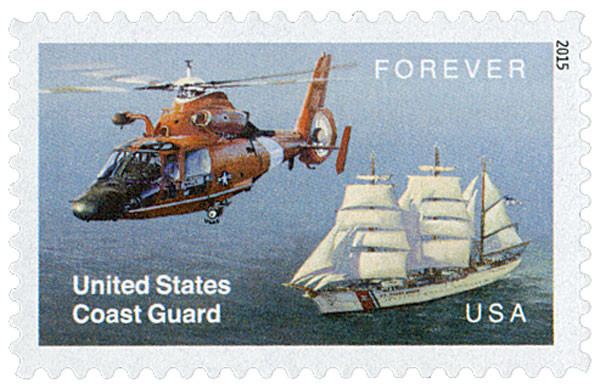
For stamp collectors, the Coast Guard's rich history offers potential themes for collecting, including commemorative stamps that reflect its evolution and significant contributions to maritime safety and security.
To learn more about the United States Coast Guard and its storied past, visit this website.