

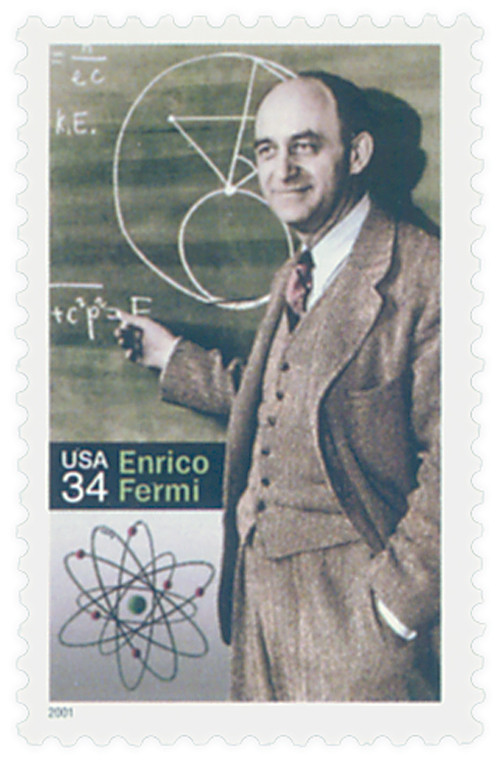
Summary of Enrico Fermi
Enrico Fermi, an Italian and naturalized American physicist, is celebrated for creating the first artificial nuclear reactor, Chicago Pile-1, and for his involvement in the Manhattan Project. His exceptional skills in both theoretical and experimental physics earned him the title of the "architect of the nuclear age". Fermi received the Nobel Prize in Physics in 1938 for his groundbreaking work in induced radioactivity and the discovery of transuranium elements, contributing significantly to statistical mechanics, quantum theory, and nuclear physics.
Fermi made substantial advancements in statistical mechanics, famously applying Wolfgang Pauli's exclusion principle to ideal gases, which led to the formulation known as Fermi-Dirac statistics. He proposed the existence of an uncharged particle called the "neutrino", contributing to the understanding of weak interaction in physics. His experiments with neutrons revealed that slow neutrons are more efficiently captured by atomic nuclei, ultimately leading to his discovery of nuclear fission products, for which he was later awarded the Nobel Prize.
Having fled Italy due to racial laws affecting his Jewish wife, Fermi continued his groundbreaking work in the US during World War II, leading efforts to achieve the first self-sustaining nuclear chain reaction. Postwar, he was instrumental in establishing nuclear research institutions and advising on nuclear policy. Although he contributed notably to particle physics, including evaluating cosmic rays, Fermi opposed the hydrogen bomb's development on ethical grounds. Many scientific projects and entities bear his name, highlighting his enduring legacy in the field.
Source: Enrico Fermi
Phenom Stores LLC is an affiliate partner for eBay.com and receives a commission on all purchases made through eBay.com.